
What Is TRON Energy for P2P Merchants
TRON energy for p2p merchants pays for the computational work of a USDT transfer. Renting it converts a daily burn of TRX into a small, predictable cost. When you send USDT on TRON without energy, the network takes TRX from your wallet. The rate is 100 SUN per energy unit. This protocol parameter, getEnergyFee, changes only by governance vote. A standard USDT transfer to an address that already holds USDT consumes 64,285 energy, which means the network burns 6.43 TRX to cover it.
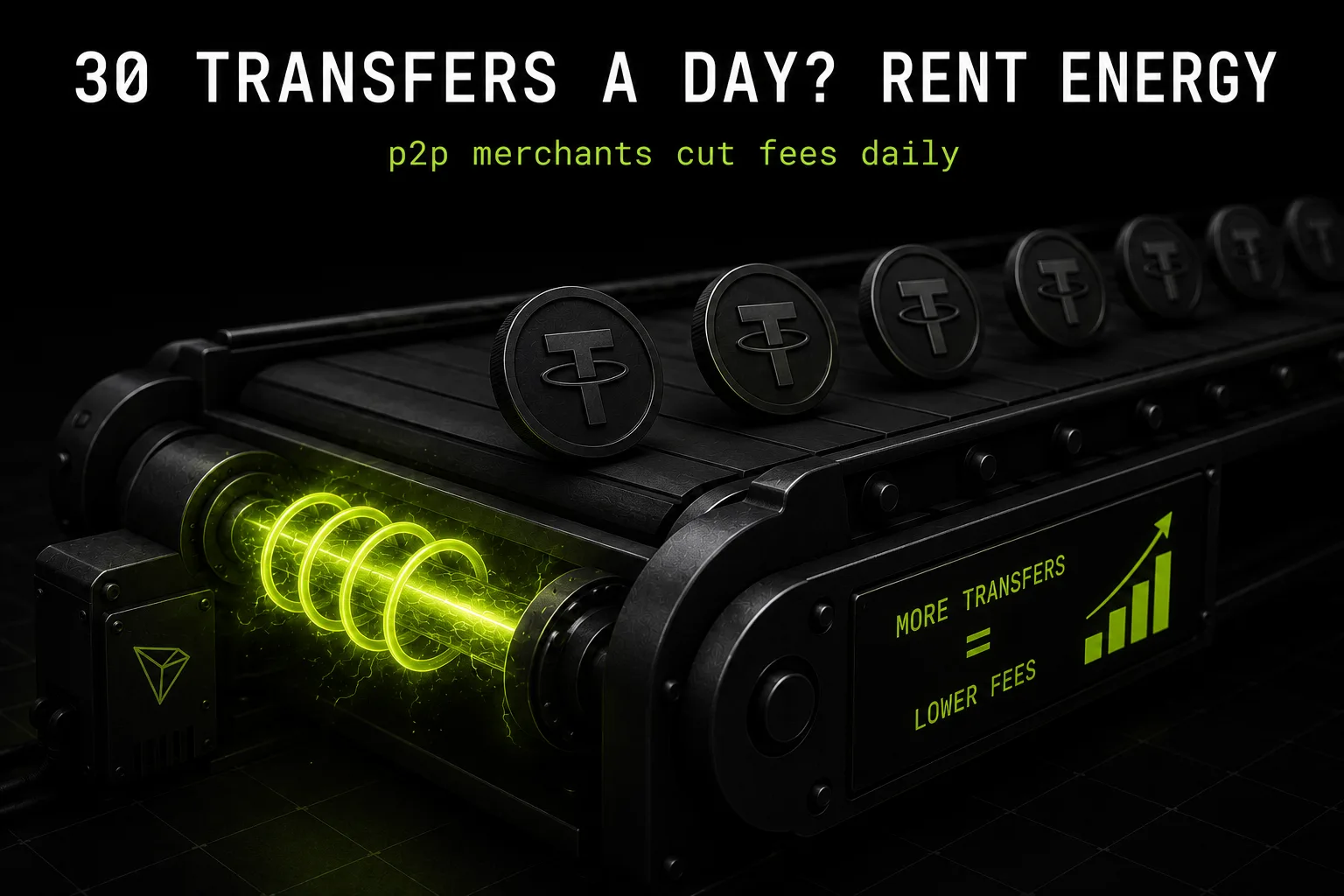
At merchant volumes, that burn stops being a rounding error. Each transfer carries the same fixed cost regardless of the amount you send, so moving 10 USDT or 10,000 USDT burns the same TRX. For a P2P merchant who settles dozens of trades a day, the network fee compounds into a serious line item. The alternative is to rent energy for the day, which replaces the burn with a rental fee that is a fraction of what the network would take.
This guide walks through the exact numbers measured on 2026-08-17, shows how to verify each figure on-chain, and explains the practical setup a merchant needs. The goal is simple. You should know what each transfer costs. You should know the cost with rented energy. Then check whether the switch pays off for your volume.
How Much Do Daily USDT Transfers Cost Without Energy
The Arithmetic Per Transfer
Every USDT transfer on TRON needs a fixed amount of energy, and the network charges 100 SUN per unit when you do not have it. The measured numbers from 2026-08-17 are straightforward: a transfer to an address that already holds USDT consumes 64,285 energy, which burns 6.43 TRX. At the TRX price of $0.3329 on that day, that single transfer cost about $2.14.
The burn is identical whether you send 5 USDT or 5,000 USDT. The energy requirement depends on the contract call, not the token amount. That fact is why the fee feels disproportionate on small P2P trades — the network cost is fixed while your margin scales with the trade size. For a merchant moving modest amounts frequently, the fee can easily exceed the profit on smaller deals.
The Daily Cost at Merchant Volumes
Multiply that single-transfer cost by the number of transfers a merchant makes in a day, and the burn becomes a daily tax on the business. Ten transfers burn 64.3 TRX — about $21.40 at the measured price. Twenty transfers double that. Fifty transfers burn 321.4 TRX, which is roughly $107 on the day those numbers were measured.
The exact figure depends on your volume. The TRON energy calculator has a per-day slider. You can see the number for your own operation. The pattern is what matters: the burn scales linearly with your transfer count, so there is no volume at which it becomes negligible. Every additional trade adds another full network fee on top of your costs.
Why Fresh Addresses Double the Energy Cost
A USDT transfer to a fresh address that never held USDT consumes 130,285 energy — more than double the 64,285 required for an address that already holds the token. The network burns 13.03 TRX for that transfer, which was about $4.34 at the measured TRX price. This is a frequent surprise in P2P flows because counterparties rotate wallets regularly.
A buyer may create a new wallet for each trade. You may pay out to a customer who just set up their address. In both cases, you pay the higher rate without warning. The transfer looks identical from your side; only the on-chain state of the recipient's address changes the cost. A merchant who pays out to unfamiliar addresses can see their average cost per transfer drift well above the single-transfer baseline.
The practical takeaway is to check the recipient address before sending. If the address has never held USDT, the transfer costs roughly double. That check takes seconds and prevents an avoidable burn. The how much energy USDT transfer needs: 65k or 131k guide explains the difference in detail. It also shows how to spot a fresh address before you commit the fee.
How to Rent Energy for a Day of P2P Transfers
Renting energy for a day is a three-step process that replaces the per-transfer burn with a single rental fee. The rental covers your transfers for the rental period, and the network consumes the delegated energy instead of burning TRX from your wallet. Measured on 2026-08-17, renting 65,000 energy for one hour cost 28.68 SUN per energy unit at the cheapest measured rate — 1.84 TRX for a 65k transfer, saving about 71% versus burning.
- Check the recipient address — verify whether the destination already holds USDT, because a fresh address needs 130,285 energy rather than 64,285. This determines how much energy you need to rent.
- Rent energy for the day — choose a rental period that covers your trading hours and an amount that covers your expected transfer count. The rent TRON energy for TronLink guide walks through the process without requiring you to share private keys.
- Verify the delegation — confirm the energy is active on your address before sending transfers. A quick check on Tronscan shows the delegated energy and its remaining duration.
Step 1: Check the Recipient Address
Before each payout, confirm whether the destination address has ever held USDT. Fresh addresses double the energy requirement, so a merchant who skips this check can burn far more than planned. The check takes seconds on a block explorer and should become part of the payout routine.
Step 2: Rent Energy for the Day
Renting converts the fee into a small predictable cost. Instead of burning 6.43 TRX per transfer, you pay a rental fee that covers many transfers for the rental period. The rent TRON energy overview explains the mechanics, including why the rental replaces the burn rather than adding to it.
Step 3: Verify the Delegation
After renting, confirm the energy is live on your address. A failed transfer because you assumed the delegation was active is worse than the fee you tried to avoid. The how to read Tronscan transaction guide shows how to verify the delegation. It also shows how to verify the fee on any transfer.
Comparing Rental vs Burning vs Self-Staking
What Burning Costs
Burning means sending the transfer without energy and letting the network take TRX from your wallet at 100 SUN per unit. For a 64,285-energy transfer, that is 6.43 TRX — about $2.14 at the measured price. For a fresh address, it is 13.03 TRX, about $4.34. The cost is certain, immediate, and repeats on every single transfer.
What Renting Costs
Renting energy for the day replaces the per-transfer burn with a flat rental fee. Measured on 2026-08-17, the cheapest rate was 28.68 SUN per energy unit — 1.84 TRX for a 65k transfer. That saves about 71% versus burning the same transfer. The rental price moves during the day, and today's Stronara price is on the main page.
What Self-Staking Requires
Self-staking means freezing TRX to receive energy as a reward. It requires locking significant capital, and the energy you receive is proportional to the amount frozen. For a merchant moving dozens of transfers daily, the capital required to cover that energy demand is substantial. It only pays off at very large volumes where the locked capital earns enough energy to justify the opportunity cost.
| Option | Cost per 65k transfer | Capital required | Notes |
|---|---|---|---|
| Burning | 6.43 TRX ($2.14) | None | Repeats on every transfer |
| Renting | 1.84 TRX | None | Flat fee, saves about 71% |
| Self-staking | Energy reward | Significant TRX locked | Only pays at very large scale |
How to Check Whether Renting Pays Off for Your Volume
- Count your daily transfers. Include every USDT payout. Not just the large ones. The burn applies per transfer regardless of amount.
- Note the ratio of fresh addresses — if many recipients use new wallets, your average cost per transfer is closer to the 13.03 TRX figure than the 6.43 TRX baseline.
- Multiply your daily count by the per-transfer burn — this is your current daily cost without energy. Compare it to the rental fee for the same day.
- Check the live rental price — rental prices move during the day, and today's Stronara price is on the main page. The measured snapshot from 2026-08-17 is a starting point, not a promise.
- Use the calculator for your exact volume. The TRON energy calculator has a per-day slider. It computes the saving for your transfer count.
The break-even point depends on your volume and the share of fresh addresses you encounter. A merchant sending a handful of transfers daily may find the rental fee comparable to the burn. One sending dozens of transfers daily will almost certainly save, because the rental covers many transfers for less than the cost of a single burn. The burn TRX or rent energy comparison lays out the full math for both scenarios.
Which Option Fits Your P2P Operation
For most P2P merchants, renting energy for the day is practical. It converts an unpredictable per-transfer burn into a flat fee. No capital is locked. The measured numbers from 2026-08-17 show a 71% saving on a 65k transfer, and that saving compounds with every additional transfer you send. Self-staking only becomes competitive at very large volumes where the locked TRX earns enough energy to justify the capital commitment.
The decision comes down to your transfer count and your tolerance for locking capital. If you send a handful of transfers a day, the rental fee may be close to the burn, and the choice is less clear. If you send dozens, the rental is almost certainly cheaper — and it carries none of the capital requirements of self-staking. The energy vs bandwidth guide explains why energy is the resource that matters for USDT transfers specifically.
Start by measuring your actual volume and checking the live rental price. The buy in 60 seconds page shows how fast the setup can be. The calculator on the main page gives the exact saving for your daily transfer count. The numbers are measurable and the date is known. Every figure in this guide can be verified on-chain. That is what a merchant needs to decide without guesswork.