
What Is TRON Energy Delegation?
The Direct Answer
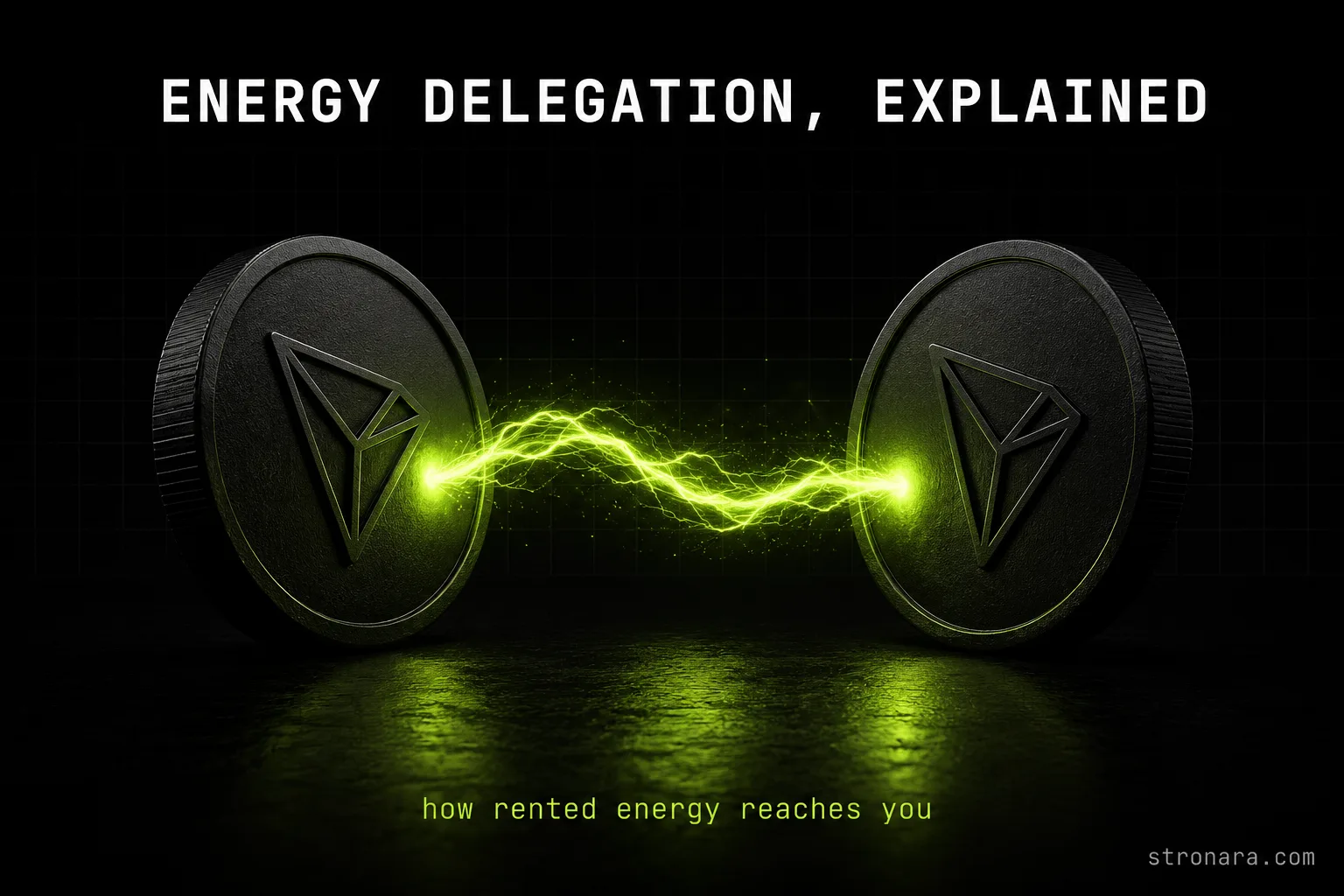
TRON energy delegation is a built-in protocol feature that lets one address share the energy generated by its staked TRX with any other address, without transferring the TRX itself. When someone delegates energy to you, they point a portion of their staked resources at your wallet, and you can spend that energy on transactions like USDT transfers. The TRX never moves; only the derived resource is redirected.
This mechanism is native to the TRON blockchain, not a smart-contract trick invented by rental services. The DelegateResource operation is part of the protocol itself, which means every delegation is recorded on-chain and visible to anyone. Understanding how energy delegation works matters because it is the foundation of the entire TRON fee economy.
Key Terms: Energy, Bandwidth, and TRX
Before going deeper, three terms need to be clear. Energy is the resource that pays for smart-contract computation, and every USDT TRC-20 transfer consumes a fixed amount of it. Bandwidth is a separate resource that pays for ordinary transactions like sending TRX between wallets. TRX is the network's native token, and it is the only thing the network ever burns.
When you lack energy, the network takes TRX from your wallet at 100 SUN per missing unit. When you lack bandwidth, it burns TRX at 1000 SUN per byte. Neither energy nor bandwidth is ever burned — they are consumed, spent, used up. Only TRX gets burned, and only when the sender does not hold the required resource.
Where Energy Comes From: Staking TRX
Energy originates from staking, which TRON calls freezing. When you freeze TRX, you lock it in the network's staking system, and in return you receive a daily energy allowance proportional to your stake. The TRX remains your property throughout the staking period. You can unstake it later, though the network holds it for a set period after you request release.
The amount of energy you generate depends on how much TRX you freeze and on the network's current energy parameters. A wallet holding a large stake generates enough energy for many transactions each day. A wallet with no stake generates nothing, which is why new or inactive wallets end up paying the full burn price on every transfer.
Staking is not a donation to the network. Your TRX stays in your control, and the energy it generates is a derived resource, like interest on a deposit. The key insight is that this energy can be pointed at another address — which is exactly what delegation does.
How a Delegation Looks On-Chain
When a provider delegates energy to you, the blockchain records a specific transaction type. Here is what happens step by step:
- The provider's wallet sends a DelegateResource transaction to the network, specifying your address as the recipient and the amount of energy to delegate.
- The network deducts that energy from the provider's daily allowance and credits it to your address for the agreed period.
- The transaction appears on Tronscan with a clear label showing the delegation type, the from-address, the to-address, and the energy amount.
- Your wallet now shows the delegated energy as available, and you can spend it on USDT transfers or other contract calls.
- When the rental period ends, the provider sends an UnDelegate transaction, and the energy returns to their allowance.
Both the delegate and undelegate operations are ordinary transactions, fully public and verifiable. Anyone can look up a delegation on Tronscan and confirm who provided it, how much energy was involved, and when it was revoked. There is no hidden layer and no off-chain accounting.
Why a Rental Market Exists
The Problem: Unused Energy
Most TRON wallets that stake TRX do not use their full energy allowance every day. A holder who freezes a substantial amount for governance or long-term storage generates energy that simply expires if unused. Meanwhile, active USDT senders need energy constantly but do not want to lock up capital in a stake.
This mismatch creates a natural inefficiency. The staker has an idle resource; the sender has a recurring cost. Without a way to connect them, the sender pays the full burn price on every transfer, and the staker's energy goes to waste.
The Solution: Delegation as Middleman
Energy delegation connects these two sides directly. A rental service stakes large amounts of TRX, then delegates the resulting energy to customers for a fee. The customer pays a fraction of the burn price, and the service earns a margin on the energy it would otherwise waste.
This is how the rental market works: the service is a middleman for a protocol feature that already exists. The delegation itself is identical whether it comes from an individual staker or a commercial service. The only difference is scale and pricing. Rental prices vary between services and change over time, which is why dated measurements matter more than vague claims.
Why Delegation Is Safe for the Recipient
A common question is whether accepting delegated energy gives the provider any access to your funds. It does not, and the protocol design makes that clear. Here is what delegation does and does not grant:
- The provider can only point energy at your address; they cannot withdraw, spend, or freeze any of your assets.
- Delegation is one-directional. The provider sends a resource; they receive nothing from you in return except whatever fee you agreed to pay off-chain.
- The recipient does not need to approve or sign anything. Delegation requires nothing from you but an address.
- The provider can undelegate after the agreed period, which simply removes the energy — it never touches your balance.
- The entire history is on-chain, so a provider who behaves badly leaves a permanent public record.
The only practical risk is the rental service itself. A dishonest provider could take your payment and undelegate early. That is a business risk, not a blockchain risk. For a deeper look at what a legitimate service can and cannot access, see Is TRON Energy Rental Safe? What a Legit Service Can Access.
How to Read a Delegation on Tronscan
Verifying a delegation on Tronscan takes about two minutes. Here is the process:
- Open Tronscan and paste the transaction hash from your transfer into the search bar.
- Look at the transaction type field. A delegation appears as "DelegateResource" or "UnDelegateResource" — not as a regular transfer.
- Check the from-address and to-address. The from-address is the provider; the to-address is the recipient, which should be your wallet.
- Read the resource type field. It should say "ENERGY" — bandwidth delegations are a different resource.
- Note the amount in the data field. This shows how much energy was delegated, typically in units of energy.
- Cross-reference the timestamp with your rental period to confirm the delegation was active when you made your transfer.
This verification method is the same one we use for every price measurement in our articles. For a full walkthrough of reading transaction details, see How to Read Tronscan Transaction: Verify Your USDT Fee.
Cost Comparison: Delegation vs Burning TRX
Measured Costs
On 2026-08-06, we measured live network parameters and rental prices. The network burns 100 SUN per energy unit, a parameter set by governance vote. A USDT transfer to an address that already holds USDT consumes 64,285 energy, which costs 6.43 TRX if burned. A transfer to a fresh address that never held USDT consumes 130,285 energy, costing 13.03 TRX if burned. At the measured TRX price of $0.3269, those burns are about $2.1 and $4.26.
On that same day, the cheapest measured rental was Stronara at 31.6 SUN per energy unit, which comes to 2.03 TRX for a 65,000-energy transfer. Rental prices move during the day, and today's Stronara price is on the main page. The table below compares the costs.
| Scenario | Energy Used | Cost if Burned | Cost with Rental (measured 2026-08-06) |
|---|---|---|---|
| USDT to existing address | 64,285 | 6.43 TRX (~$2.1) | 2.03 TRX (31.6 SUN/unit) |
| USDT to fresh address | 130,285 | 13.03 TRX (~$4.26) | ~4.12 TRX (31.6 SUN/unit) |
What You Save
On the day we measured, renting energy instead of burning TRX saved about 68% on a standard 65,000-energy transfer. The savings come from the difference between the burn price of 100 SUN per unit and the rental price of 31.6 SUN per unit. The network burns TRX only when you lack energy; renting removes that burn entirely.
These numbers are a snapshot, not a promise. Rental prices change throughout the day, and network parameters can shift with governance votes. What does not change is the mechanism: burning costs 100 SUN per unit, and any rental below that saves you money. For a live comparison of current rates, see Cheapest TRON Energy Today: Stronara at 33.74 SUN/Unit.
Frequently Asked Questions
Does delegation give the provider access to my wallet? No. Delegation is one-directional and grants no control over your funds. The provider can only point energy at your address and revoke it later.
Can I delegate energy myself without a rental service? Yes. If you stake TRX, you can delegate the resulting energy to any address using the protocol's DelegateResource operation. Rental services simply do this at scale.
How long does a delegation last? The provider sets the period, typically matching the rental agreement. After the period ends, the provider sends an UnDelegate transaction to reclaim the energy. Rental periods can range from minutes to days.
What happens if the provider undelegates early? Your energy allowance drops back to zero, and your next transfer will burn TRX at the full rate. This is why choosing a reputable service matters. For more on timing, see How Long Does TRON Energy Last? Rental Periods Explained.
Is there a minimum amount of TRX I need to stake to delegate? The network sets a minimum stake for generating energy, but rental services handle this for you. You do not need to stake anything to receive delegated energy.
The Bottom Line
TRON energy delegation is a native protocol feature that lets stakers share their energy with other addresses, and it is the mechanism behind every energy rental service. The TRX stays with the staker; only the derived resource moves. Delegations are public, verifiable on Tronscan, and reversible by the provider.
For regular USDT senders, understanding TRON energy delegation is the key to cutting transfer costs. A standard transfer burns 6.43 TRX without energy, but a rental measured on 2026-08-06 cost just 2.03 TRX — a saving of about 68%. The numbers change, but the mechanism does not: delegation lets you avoid the burn entirely.
Before renting, verify the delegation on Tronscan and check the live price. The protocol is transparent, and the tools to confirm every claim are in your hands. For a broader view of how the fee system works, see Why Is TRX Gas Fee So High? The Real Reason (with Numbers).